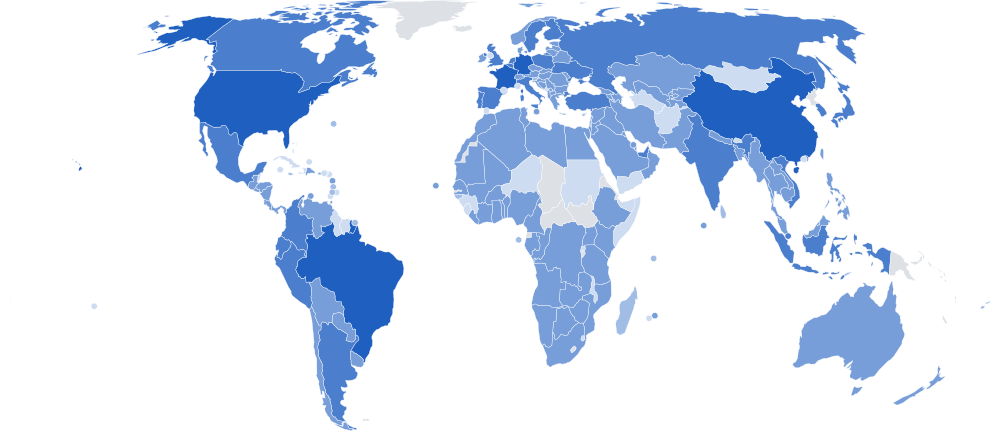
INTELIGÊNCIA ARTIFICIAL NA PESQUISA EM DISFAGIA: ANÁLISE BIBLIOMÉTRICA DAS TENDÊNCIAS GLOBAIS, TECNOLOGIAS EMERGENTES E DISPARIDADES REGIONAIS
DOI:
https://doi.org/10.66104/bvvdnr46Palavras-chave:
Transtornos de deglutição, Inteligência artificial, Aprendizado de máquina, Bibliometria, Equidade em saúdeResumo
A inteligência artificial é cada vez mais aplicada à avaliação da disfagia, mas a distribuição dessas pesquisas segundo o nível de renda dos países ainda não foi examinada. Este estudo mapeou as tendências globais, as tecnologias emergentes e as disparidades regionais na pesquisa em inteligência artificial sobre disfagia orofaríngea. A busca foi realizada na Scopus em 28 de agosto de 2026, para artigos e revisões publicados de 2016 a 2026. Os indicadores de desempenho foram calculados no Microsoft Excel, a coocorrência de palavras-chave foi mapeada no VOSviewer, e a produção foi comparada com a participação populacional por grupo de renda do Banco Mundial e por região da Organização Mundial da Saúde. Dos 738 registros, 205 estudos foram incluídos; 93,7% foram publicados a partir de 2020, com taxa de crescimento anual composta de 42,3%. Os Estados Unidos, a China e a Coreia do Sul lideraram a produção. A videofluoroscopia foi a fonte de dados mais frequente (43,4%), enquanto os modelos baseados em dados clínicos, em sensores eletrofisiológicos e vestíveis e em grandes modelos de linguagem foram os que mais cresceram. Os países de alta renda, onde vivem cerca de 17% da população mundial, produziram 72,6% dos estudos; nenhum estudo veio de países de baixa renda ou da Região Africana, e a América Latina contribuiu com 7,3%. A maior parte do crescimento recente ocorreu em abordagens não invasivas que poderiam ser utilizadas em serviços sem videofluoroscopia ou endoscopia. A validação externa desses modelos em populações latino-americanas, africanas e do sudeste asiático é necessária, preferencialmente em estudos multicêntricos com parceiros de países de baixa e média renda.Downloads
Referências
Anwar, A., et al. “Videographic-Free Tracking of Hyoid Bone Displacement during Swallowing Using Accelerometer Signals and Transformers.” IEEE Journal of Translational Engineering in Health and Medicine, vol. 13, 2025, pp. 402–12.
Araújo, L., et al. “Artificial Intelligence and Image Processing Framework for Automated Airway Invasion Detection and Residue Classification from Swallowing Endoscopy.” Scientific Reports, vol. 16, 2026, article 16949.
Azimzadeh, S., et al. “Reforms and Innovations in Primary Health Care in Different Countries: Scoping Review.” Primary Health Care Research & Development, vol. 25, 2024, article e22.
Baijens, L. W., et al. “European Society for Swallowing Disorders – European Union Geriatric Medicine Society White Paper: Oropharyngeal Dysphagia as a Geriatric Syndrome.” Clinical Interventions in Aging, vol. 11, 2016, pp. 1403–28.
Caulder, E., et al. “Geographic Inequality in Funding by National Institutes of Health Negatively Impacts Almost One-Half of the States in the United States.” Frontiers in Public Health, vol. 12, 2024, article 1452494.
Clavé, P., and R. Shaker. “Dysphagia: Current Reality and Scope of the Problem.” Nature Reviews Gastroenterology & Hepatology, vol. 12, 2015, pp. 259–70.
da Silva, R. D., et al. “Artificial Intelligence in the Diagnosis and Management of Dysphagia: A Scoping Review.” CoDAS, vol. 37, 2025, article e20240305.
Dean, J., et al. “Incorporating Spatial Dose Metrics in Machine Learning-Based Normal Tissue Complication Probability (NTCP) Models of Severe Acute Dysphagia Resulting from Head and Neck Radiotherapy.” Clinical and Translational Radiation Oncology, vol. 8, 2018, pp. 27–39.
Donthu, N., et al. “How to Conduct a Bibliometric Analysis: An Overview and Guidelines.” Journal of Business Research, vol. 133, 2021, pp. 285–96.
Fakhry, A., et al. “Deep Learning for Video Fluoroscopic Swallowing Study Analysis: A Survey on Classification, Detection, and Segmentation Techniques.” IEEE Access, vol. 13, 2025, pp. 94239–55.
Ferrari de Castro, M. A., et al. “Endoscopic and Videofluoroscopic Evaluations of Swallowing for Dysphagia: A Systematic Review.” Brazilian Journal of Otorhinolaryngology, vol. 91, 2025, article 101598.
GBD 2021 Stroke Risk Factor Collaborators. “Global, Regional, and National Burden of Stroke and Its Risk Factors, 1990–2021: A Systematic Analysis for the Global Burden of Disease Study 2021.” The Lancet Neurology, vol. 23, 2024, pp. 973–1003.
Girardi, A. M., et al. “Artificial Intelligence in the Interpretation of Videofluoroscopic Swallow Studies: Implications and Advances for Speech–Language Pathologists.” Big Data and Cognitive Computing, vol. 7, 2023, article 178.
Khalifa, Y., et al. “Non-Invasive Identification of Swallows via Deep Learning in High Resolution Cervical Auscultation Recordings.” Scientific Reports, vol. 10, 2020, article 8704.
Khodami, F., et al. “Elevating Patient Care with Deep Learning: High-Resolution Cervical Auscultation Signals for Swallowing Kinematic Analysis in Nasogastric Tube Patients.” IEEE Journal of Translational Engineering in Health and Medicine, vol. 12, 2024, pp. 711–20.
Koo, W. W. “Cross-Lingual Effects of AI-Generated Content on Human Work.” Scientific Reports, vol. 15, 2025, article 30949.
Labeit, B., et al. “Costs of Post-Stroke Dysphagia during Acute Hospitalization from a Health-Insurance Perspective.” European Stroke Journal, vol. 8, 2023, pp. 361–69.
Lai, D. K. H., et al. “Computer-Aided Screening of Aspiration Risks in Dysphagia with Wearable Technology: A Systematic Review and Meta-Analysis on Test Accuracy.” Frontiers in Bioengineering and Biotechnology, vol. 11, 2023, article 1205009.
Lee, S. J., et al. “Automatic Detection of Airway Invasion from Videofluoroscopy via Deep Learning Technology.” Applied Sciences, vol. 10, 2020, article 6179.
Liu, T., et al. “Artificial Intelligence in Dysphagia since the 21st Century: A Bibliometric and Visualization Study.” Frontiers in Medicine, vol. 12, 2025, article 1624381.
Maldonado, A., et al. “Bibliometric Analysis of 25 Years of Emergency Medicine Research in Latin America.” The Journal of Emergency Medicine, vol. 76, 2025, pp. 124–34.
Onitsuka, T., et al. “Trends in Big Data Analyses by Multicenter Collaborative Translational Research in Psychiatry.” Psychiatry and Clinical Neurosciences, vol. 76, 2022, pp. 1–14.
Patelli, A., et al. “Geography of Science: Competitiveness and Inequality.” Journal of Informetrics, vol. 17, 2023, article 101357.
Rajati, F., et al. “The Global Prevalence of Oropharyngeal Dysphagia in Different Populations: A Systematic Review and Meta-Analysis.” Journal of Translational Medicine, vol. 20, 2022, article 175.
Ravi, R., et al. “Bibliometric Analysis of Global Research Trends in Pediatric Hearing Impairment.” European Annals of Otorhinolaryngology, Head and Neck Diseases, vol. 143, 2026, pp. 291–96.
Rech, R. S., et al. “Speech-Language Therapy Offer and Primary Health Care in Brazil: An Analysis Based on Socioeconomic Development.” CoDAS, vol. 31, 2019, article e20180083.
Ribeiro, M., et al. “The Prevalence of Oropharyngeal Dysphagia in Adults: A Systematic Review and Meta-Analysis.” Dysphagia, vol. 39, 2024, pp. 163–76.
Roldan-Vasco, S., et al. “Dysphagia Screening with sEMG, Accelerometry and Speech: Multimodal Machine and Deep Learning Approaches.” Biomedical Signal Processing and Control, vol. 100, 2025, article 107030.
Storey, E., et al. “Language Bias in Self-Supervised Learning for Automatic Speech Recognition.” arXiv, 2025, arXiv:2501.19321.
Sun, W., et al. “Study on Dysphagia from 2012 to 2021: A Bibliometric Analysis via CiteSpace.” Frontiers in Neurology, vol. 13, 2022, article 1015546.
van Eck, N. J., and L. Waltman. “Software Survey: VOSviewer, a Computer Program for Bibliometric Mapping.” Scientometrics, vol. 84, 2010, pp. 523–38.
World Bank. “World Bank Country and Lending Groups.” World Bank Data Help Desk, datahelpdesk.worldbank.org/knowledgebase/articles/906519. Accessed 24 Oct. 2026.
Xu, G., et al. “Assessing the Use of Automatic Speech Recognition and Large Language Models for Individuals with Language Impairments.” Nature Communications, vol. 17, 2026, article 10716.
Zhu, J., and W. Liu. “A Tale of Two Databases: The Use of Web of Science and Scopus in Academic Papers.” Scientometrics, vol. 123, 2020, pp. 321–35.

Publicado
Edição
Seção
Licença
Direitos autorais (c) 2026 Isabel Cristina Sabatini Perez-Ramos, Alexandre C. R. Ramos

Este trabalho está licenciado sob uma licença Creative Commons Attribution 4.0 International License.
Autores que publicam nesta revista concordam com os seguintes termos:
- Autores mantém os direitos autorais e concedem à revista o direito de primeira publicação, com o trabalho simultaneamente licenciado sob a Licença Creative Commons Attribution que permite o compartilhamento do trabalho com reconhecimento da autoria e publicação inicial nesta revista;
- Autores têm autorização para assumir contratos adicionais separadamente, para distribuição não-exclusiva da versão do trabalho publicada nesta revista (ex.: publicar em repositório institucional ou como capítulo de livro), com reconhecimento de autoria e publicação inicial nesta revista, desde que adpatado ao template do repositório em questão;
- Autores têm permissão e são estimulados a publicar e distribuir seu trabalho online (ex.: em repositórios institucionais ou na sua página pessoal) a qualquer ponto antes ou durante o processo editorial, já que isso pode gerar alterações produtivas, bem como aumentar o impacto e a citação do trabalho publicado (Veja O Efeito do Acesso Livre).
- Os autores são responsáveis por inserir corretamente seus dados, incluindo nome, palavras-chave, resumos e demais informações, definindo assim a forma como desejam ser citados. Dessa forma, o corpo editorial da revista não se responsabiliza por eventuais erros ou inconsistências nesses registros.
POLÍTICA DE PRIVACIDADE
Os nomes e endereços informados nesta revista serão usados exclusivamente para os serviços prestados por esta publicação, não sendo disponibilizados para outras finalidades ou a terceiros.
Obs: todo o conteúdo do trabalho é de responsabilidade do autor e orientador.